Records from the sea of islands: The Pacific and Regional Archive for Digital Sources in Endangered Cultures (PARADISEC)

Nick Thieberger works for the Pacific and Regional Archive for Digital Sources in Endangered Cultures (PARADISEC) and the University of Melbourne
The distance between major population centres in the Pacific makes it difficult for residents of the sea of islands to access records in their languages. Even if records are stored in national museums or cultural centres, that can be some distance from most of the population. As the internet becomes more widely available, connection to these records becomes more feasible, but that requires the records to be described, digitised, and made accessible.
Breaking down barriers to implement digital preservation

Jaye Weatherburn, Program Manager Digital Preservation and Elise Bradshaw, Digital Curation and Archives Specialist work at the University of Melbourne
Supporting digital connections
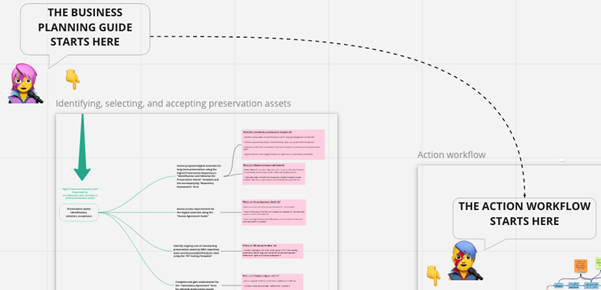
The theme of this year’s World Digital Preservation Day, “Breaking Down Barriers” connects with some work we have currently underway to realise the University of Melbourne’s 10-year digital preservation strategy. This year in a big effort to build and support connections between the distributed teams contributing to the success of long-term digital preservation at the university, we have been working on a collaborative planning and implementation process for long-term preservation of university records.
Digitisation and digital preservation practice – making archives available and keeping it accessible (part 3)

Ros Malone is School Archivist for Bunbury Cathedral Grammar School in Perth, Australia
Image Keys: Easing Barriers to Retrieval in the School Archives
It’s a familiar problem for many Schools and School Archives, and indeed for collections of all kinds – what can be done with our vast collection of untitled, un-tagged digital images?
Digitisation and digital preservation practice – making archives available and keeping it accessible (part 2)
Rosemary Grace Bruce-Mullins is Committee Member and Member of the Research Team at the Wentworth Historical Society Inc, Australia
As a local History Society member digital preservation of records provides a multitude of benefits.
An experience where the local town hall, that housed the history society collection, was firebombed, and thankfully saved, made us aware of the reality of losing the collection, and all the information it contained.
Digitisation and digital preservation practice – making archives available and keeping it accessible (part 1)

Karuna Bhoday is Program Manager, Integrated Archival Management System Program at National Archives of Australia.
The National Archives of Australia ensures that Australian Government information of enduring significance is identified, secured, preserved and accessible for future generations.
To continue to meet our vision of being world leading archive in this digital age and to fulfil our functions now and into the future a high priority for the National Archives is to embed an end-to-end archival management capability across the organisation and to accelerate its digital transformation. The integrated Archival Management System Program (IAMS) is a Digital Transformation Project led by our Chief Information Officer.
Breaking Down Barriers: World Digital Preservation Day 2021

It’s my pleasure to announce the official start of World Digital Preservation Day.
It’s both welcome and surprising to realise that we’re now onto our fifth annual event. In the first couple of years, the simple purpose of connecting people and raising awareness about our work was sufficient. Even that seemed ludicrously ambitious in 2017. This year’s theme – Breaking Down Barriers – represents a new confidence, and perhaps a new urgency too. It’s a call to action. It’s a challenge to do something with those connections and insights that we’ve gained in the last four years. We’ve connected with colleagues around the world and formed those relationships and in 2021 we move forward together.
There’s no shortage of ambition here, but let’s be honest, there’s a need for ambition. There are enough barriers to be broken down. We’re used to thinking about digital preservation as the intersection of technology, resources and organization. There are barriers to all three of these, and the scale of the challenge only seems to grow.
Not Unchanged
The last rays of sun are now setting on the most westerly reaches of the map and we’ve all now had a chance to celebrate and participate World Digital Preservation Day. I have a brief moment – for me it’s now the morning after the night before – to offer a few immediate reflections and pick a few highlights.
Our theme for the 5th November, Digits For Good, has a neatly-constructed double meaning implying both purpose and time. Both are necessary and both were on display. I encourage you to leave your comments here on your own highlights.
It’s too early to report the full story of World Digital Preservation. This particular count is far from complete but the success is undisputed. We counted 85 blogs on the DPC website (yes that’s the most ever) from 22 countries (yes that’s the most ever). And that’s just one of the many blogging platforms: I know because I wrote for two others besides and we spotted maybe another 25 that we know of. We have counted well over 5,000 tweets - more than 4,000 on the #wdpd2020 tag and another 750 or so with #dpa2020 from around 1900 different accounts. There were at least 10 baking ‘incidents’ (I don’t count each individual cupcake or cookie) in the #BitListBakeOff. Two new initiatives - the digital preservation themed pizza and at least one digital preservation themed cocktail selection, to be enjoyed while marvelling at the musical contributions. The State Library of Queensland has made the parody video into an art form.
The EaaSI Interaction API

Euan Cochrane is the Digital Preservation Manager at Yale University Library in New Haven, CT
-
Imagine being able to migrate any data from any legacy format to any compatible modern format automatically.
-
Imagine being guided through using legacy software with real-time demonstrations and tutorials that you can interrupt and take over from at any point.
-
Imagine being able to add a screen reader to any software, enhancing accessibility.
-
Image having access to comprehensive metadata about all software titles.
We are developing Emulation as a Service Infrastructure (EaaSI) software with a long time horizon - we expect the general approach that EaaSI is enabling, i.e. the ability to be able to re-run legacy software at any point in time, to be necessary indefinitely.
2020, #WeMissiPRES and the best conference I have never attended
Steph Taylor is based in Los Angeles, USA.
I’ve worked in digital libraries and archives for a long time, and I’ve always wanted to attend the iPRES conference, but I’ve never made it. Given my many failed attempts, I was not expecting 2020, the year of the apocalypse, to be any different. But these are strange times. I heard about an online event called #WeMissiPRES, hosted by DPC and I rushed to book a place. The event was not iPRES, and the organisers (friends of iPRES), explained up front that there would be no heavy papers. Instead, they were aiming for a fringe festival, coffee shop vibe for the event. This sounded perfect.! My 2020 self needed to connect and learn, but in a gentle way.
The event itself was excellent. In recent years, there has been a shift to put more professional content online within the digital preservation community and the event benefited from this move. And in the age of the pandemic, many of us are now video conferencing experts. Organisers, speakers and delegates easily picked up the etiquette of online interactions and each session ran smoothly. There was also a social element, which was a lot of fun and helped to provide the networking element often missing with online events.
The biggest and most significant shift for me was not the technology or the well-organised programme, but the range of participants. Although I had missed out on iPRES, I’ve had a number of jobs where I’ve been privileged enough to attend many conferences. These conferences billed themselves as international, but as #WeMissiPRES unfolded, I realised that I had never attended a truly international conference. Most of my conferences had been based in Europe. There would be a lot of European-based delegates, with a smattering of people from elsewhere. I’d only been able to attend one conference outside Europe and was one of only a handful of European-based people there, with most people being from the local region. So here I was, in a time of restricted national and international travel, when many people around the world were barely leaving their own homes, participating in an actual global event.
The Business of Preservation is the Practice of Care

Justin Simpson is the Managing Director of Artefactual Systems.
Digital preservation can be a hard sell. Institutions may recognize the need. Many do not adequately prioritise the work. The return on investment for digital preservation efforts is difficult to quantify, and not achievable in a short time span.
We will not convince the world of the importance of this work in financial terms alone. While the practice of digital preservation can be understood as a business practice, I believe a more profitable framing is to consider the work of preserving and providing access to cultural memory as a practice of care.
Bernice Fisher and Joan Tronto describe caring as ‘… a species activity that includes everything that we do to maintain, continue, and repair our ‘world’ so that we can live in it as well as possible.’ [1]
This definition describes the work of caring for cultural memory just as well as it describes healthcare, or childcare, or the many other forms of caregiving. The work of caring, of all kinds, is generally undervalued, and often invisible. Our conversations about how to provide, for example, healthcare, are often restricted to purely financial concerns. Caring is then turned into a commodity for profit making, at the expense of the real value that caregiving creates.