






































































































































Preserving E-Theses Resource Pack
 The Preserving e-Theses Resources Pack, developed by the Digital Preservation Coalition in partnership with the Open Book Futures project, provides practical, flexible guidance to help universities support the long-term accessibility and use of doctoral theses.
As theses become increasingly digital—and often include data, multimedia, code, and web-based content—ensuring they remain accessible and understandable over time presents new challenges. While universities are generally responsible for preserving theses, the way they are prepared and submitted can significantly affect access, use, and reuse in the future. These resources are intended to help staff involved in the PhD submission process understand the need for digital preservation of e-theses and to support students in this area.
About the Resource Pack
This resource pack is designed primarily for staff who support doctoral students, including those working in libraries, research support, and student services. It recognises that:
-
Staff are well-placed to reach students through existing training, guidance, and submission processes.
-
Awareness of long-term access issues may vary across different staff roles.
-
Time for both staff and students is limited.
As a result, the resources aim to be:
-
Concise and practical: Focused on the most important messages and actions
-
Flexible and adaptable: Designed to be tailored according to local context and policy
-
Easy to integrate: Suitable for use in existing training, guidance, and student support activities
The pack aims to support staff in reinforcing key ideas in their interactions with students, helping them make informed decisions throughout their PhD.
Resources were developed by the Digital Preservation Coalition in collaboration with the Open Book Futures project, drawing on scoping work with students and staff across the sector to identify key challenges and opportunities in supporting the long-term accessibility of doctoral theses. This included surveys, interviews, and focus groups, which informed both the design of the resource pack and the content of the materials. We are grateful to all those who contributed their time and insights to this work.
What’s included
The resource pack includes a set of modular resources that can be used individually or together:
Staff Orientation Guide
A short introductory resource providing context on why long-term access to e-theses matters and how it relates to thesis preparation and submission. It also includes an overview of the resource pack and how the materials can be used. It is designed to build confidence and understanding, particularly for staff who may be less familiar with digital preservation.
[Download]
Quick Guides (for students)
A set of short, focused guides covering the following topics:
-
Choosing File Formats [Word Download / PDF Download]
-
Copyright and Permissions [Word Download / PDF Download]
-
Link Rot (Using Links that Last) [Word Download / PDF Download]
-
Web Archiving [Word Download / PDF Download]
Each guide is designed for quick reading and practical use, and available for download as both a PDF and an editable Microsoft Word document. They can be shared directly with students or incorporated into local resources. Institutions may wish to add links to relevant policies, guidance or support services, and tailor examples to reflect their context.
The Copyright and Permissions guide is based on UK copyright law, reflecting the UK focus of the Open Book Futures project. Institutions outside the UK are welcome to adapt this guide to align with their own local copyright frameworks and requirements.
Future Proof Your Thesis: Five Principles to Support Long-Term Use
A concise, student-facing overview of key principles to support long-term access and use. This can be used at key points in the doctoral journey—such as induction or in the lead-up to submission—to introduce core concepts in an accessible way. Institutions may wish to embed this within existing guidance or adapt the language to align with local requirements.
[Download]
Staff Reference Guide
A practical “quick reference” for staff, bringing together key messages, prompts for conversations, and suggested responses to common questions. This can be used as a just-in-time resource when supporting students. The guide includes sections that are intended to be edited and expanded, such as frequently asked questions and local support contacts.
[Download]
“Leila & Grace” (introductory video)
A brief (two-minute) video explaining why long-term access to theses matters. Aimed at students, it can be used to raise awareness—for example by embedding it in online guidance, or incorporating it into induction and training sessions.
Adapting the resources
The resource pack has been designed to be adapted and reused. As such, all materials are shared under a CC-BY-NC-SA Licence and written documents have been made available as both PDFs and editable Microsoft Word documents.
Universities are encouraged to:
-
Add links to institutional policies, guidance, and support services
-
Include locally relevant examples and frequently asked questions
-
Edit content to align with local procedures and requirements
-
Incorporate materials into existing training, workshops, and online guidance
Some sections are intentionally designed with placeholders or prompts to support this process.
Let us know what you think!
We are keen to hear how these resources are being used in practice. Have they been helpful? Is there anything that could be improved?
If you have feedback or are willing to share examples of how you have used, adapted, or incorporated these resources into your own guidance or training, we would love to hear from you. Email us at info@dpconline.org.
| Suggested citation of current version | Digital Preservation Coalition (2026). Preserving E-Theses Resource Pack, 1st Edition, [http://doi.org/10.7207/ethesesresource26-01] |
| Last updated | June 2026 |
| Date of next planned review | June 2029 |
Digital Preservation Learning Resources Portal
The DPC hosts and maintains a community registry of digital preservation learning resources, open to all to use and edit. Originally developed as part of the iPRES 2024 Start to Preserve Stream and officially launched in March 2025, it aims to help digital preservation practitioners, educators, and students find training and development opportunities and content. We hope, over time, it will grow to become the "go to" place for those in the digitial preservation community to find resources to help build their skills and knowledge.
Adding Content
Contributions and updates are welcome from anyone and resources listed can be anything from training or a conference through to a useful book or article. So, if you’ve taken an interesting course or found a great new resource you’d like to share, please do add it!
Please note: to add to the resource you must be logged in to a GitHub account.
Mental Health and Wellbeing in the Digital Preservation Community
The DPC's strategic plan provides a mandate to support the development of a "competent and responsive workforce that is ready to address the challenges of digital preservation." With practitioners coping with a variety of pressures including limited budgets, the challenge of advocacy, fragmented roles, and unrealistic workloads, we recognize the need for responsive support for the mental health and wellbeing of those working in digital preservation.
Mental Health and Wellbeing Community Research
In 2023, the DPC circulated a community survey to gather the data needed to establish a baseline picture of mental health and wellbeing in the digital preservation community. The findings report is now available below, along with the executive summary provided as a separate publication and a dataset including anonymized quantitative data from the survey.
- Mental Health and Wellbeing in the Digital Preservation Community: 2023 Survey Findings Report
- Mental Health and Wellbeing in the Digital Preservation Community: 2023 Survey Findings Report Executive Summary
- Anonymized Quantitative Data from the 2023 Mental Health and Wellbeing in Digital Preservation Community Survey
Attributions for the report should be as follows:
Digital Preservation Coalition, Mental Health and Wellbeing in the Digital Preservation Community: 2023 Survey Findings Report, https://doi.org/10.7207/mhw2025, 2025
Labour Market Analysis
|
As part of its strategic commitments to workforce development, the DPC undertakes studies on the digital preservation labour market, analyzing data gathered from online job advertisements. The main objective of these analyses is to facilitate recruitment, staff management, and career development of DPC members by capturing and sharing information specific to the digital preservation labour market, using what is found to help develop and shape the outputs of the DPC Workforce Development program. By sharing the information gathered through the analyses more widely, the DPC aims to facilitate the knowledge and development of those in the digital preservation field and invite further discussion and practical use by digital preservation practitioners. |
 |
DPC Labour Market Analysis Resources
The following resources are available for reference or use by the wider digital preservation community.
-
The DPC Summary Report on the 2021-2022 Digital Preservation Labour Market and accompanying Dataset
-
The previous 2020 DPC Labour Market Analysis Summary Report
These resources are made available for use and reuse under a Creative Commons Attribution-NonCommercial-ShareAlike 4.0 International (CC BY-NC-SA 4.0) license. In summary, this means they can be freely shared and adapted as long as proper attribution is made, that it is for non-commercial purposes, and any resources that remix, transform, or build upon the content carry the same license, allowing reuse.
Acknowledgements
The DPC Labour Market analyses build on and draw from previous research and work including, but not limited to, the DigCurV lenses and the DigCCur Curriculum Matrix, NDSA Levels of Digital Preservation and NDSA Staffing Survey reports, University of Maine Digital Curation market analyses, as well as the DPC Rapid Assessment Model and DPC Competency Framework, Audit Toolkit and example role descriptions. Thanks also go to colleagues within the DPC team and members of the DPC's Workforce Development Sub-Committee for their support, feedback, insights, and encouragement during the development of the research and report.
Feedback and Review
The DPC is committed to the ongoing support and development of the Labour Market analysis. We welcome feedback on all DPC resources and incorporate from the digital preservation community. All feedback received will be carefully considered, with input from the DPC Workforce Development Sub-Committee, for the next labour market analysis planned for 2025-2026. To provide feedback, please email info@dpconline.org.
Role Descriptions
This page describes two of the key roles required to facilitate the Python Study Group (PSG) program. Each includes a person description, details of the time commitment, and the responsibilities that are included within the role.
Governance Group Member
The Python Study Group governance group will meet two times a year, with ad hoc meetings as needed, to conduct oversight of the Python Study Groups program.
The governance group will comprise six total members: five voting representatives and one non-voting DPC staff member who will fulfil an administrative role. Of the voting members, at least one will be a member of staff of the DPC and another a staff or committee member of the BCC. The remaining three voting members are open to participants in the Python Study Group program community who are members of DPC or BCC. Ideally, at least one member will be/have been a participant in the program and one member will be/have been a mentor.
Person Description
Volunteers for the PSG governance group will:
-
Be a digital preservation practitioner or program manager in good standing within the community.
-
Have an interest in the use of Python to facilitate digital preservation activities
-
Practical coding skills are not a requirement.
-
-
Have an interest in or knowledge of education and/or professional development, particularly in relation to technical skills.
-
Be community minded, collaborative, and committed to increasing equity, diversity, and inclusion within digital preservation.
Time Commitment
It is expected that participation in the governance group will involve a maximum of 10-15 hours a year. Members are expected to commit to participating in the group for a minimum of a year.
Responsibilities:
-
Attendance at virtual biannual governance group meetings, and ad hoc meetings as required
-
Participate in the resolution of any Code of Conduct violations or other violations of the Terms of Reference
-
Contribute to the administration of annual evaluations of the Python Study Group program
-
Make recommendations on programmatic changes based on feedback received
-
Participate in subcommittees as needed, e.g. an every-other-year curriculum review committee
-
Contribute to strategic planning for the Python Study Groups program
-
Help steward the Python Study Groups GitHub repositories, particularly through content management
Study Group Mentor
Although it is hoped that study groups will be largely self-driven, it will be useful for participants to be able to consult with experienced practitioners from time to time. This might be to ask advice on a particular approach or for help when having issues with a script. For this reason, the PSG program hopes to recruit a small team of volunteer mentors to help support participants in their learning.
Mentors will provide support to study group participants in two forms:
-
By being available during study group meetings to drop-in to groups who require advice.
-
By responding to pull requests posted by participants on the PSG GitHub repository detailing coding issues they are experiencing.
Particular responsibilities will be assigned after recruitment, to be determined by the number of mentors recruited and their task preferences.
Person Description
PSG Mentors will:
-
Be a digital preservation practitioner or program manager in good standing within the community.
-
Be proficient in coding with Python.
-
Have experience of utilizing Python to complete digital preservation tasks.
-
Be familiar with GitHub.
-
Have an interest in or knowledge of skills development.
-
Be community minded, collaborative, and committed to increasing equity, diversity, and inclusion within digital preservation.
Time Commitment
The time commitment required from PSG mentors is somewhat dependent on the number of mentors the program is able to recruit. However, it is expected that acting as a PSG Mentor will involve a commitment of around 10 hours a PSG cycle (6 months). Mentors are expected to commit to participating in the PSG program for a minimum of one cycle.
Responsibilities:
-
Attend a mentor briefing meeting at the beginning of each PSG program cycle
-
Attend PSG meetings as required based on an agreed rota (no more than one a month)
-
Provide guidance on python coding to participants at PSG meetings when requested
-
-
Respond to pull requests on the PSG GitHub as required based on an agreed rota of availability
-
Guidance may include problem solving and/or feedback on scripts posted by participants
-
-
Provide feedback to the governance group on the PSG program at the end of each cycle
DPC Reading Club
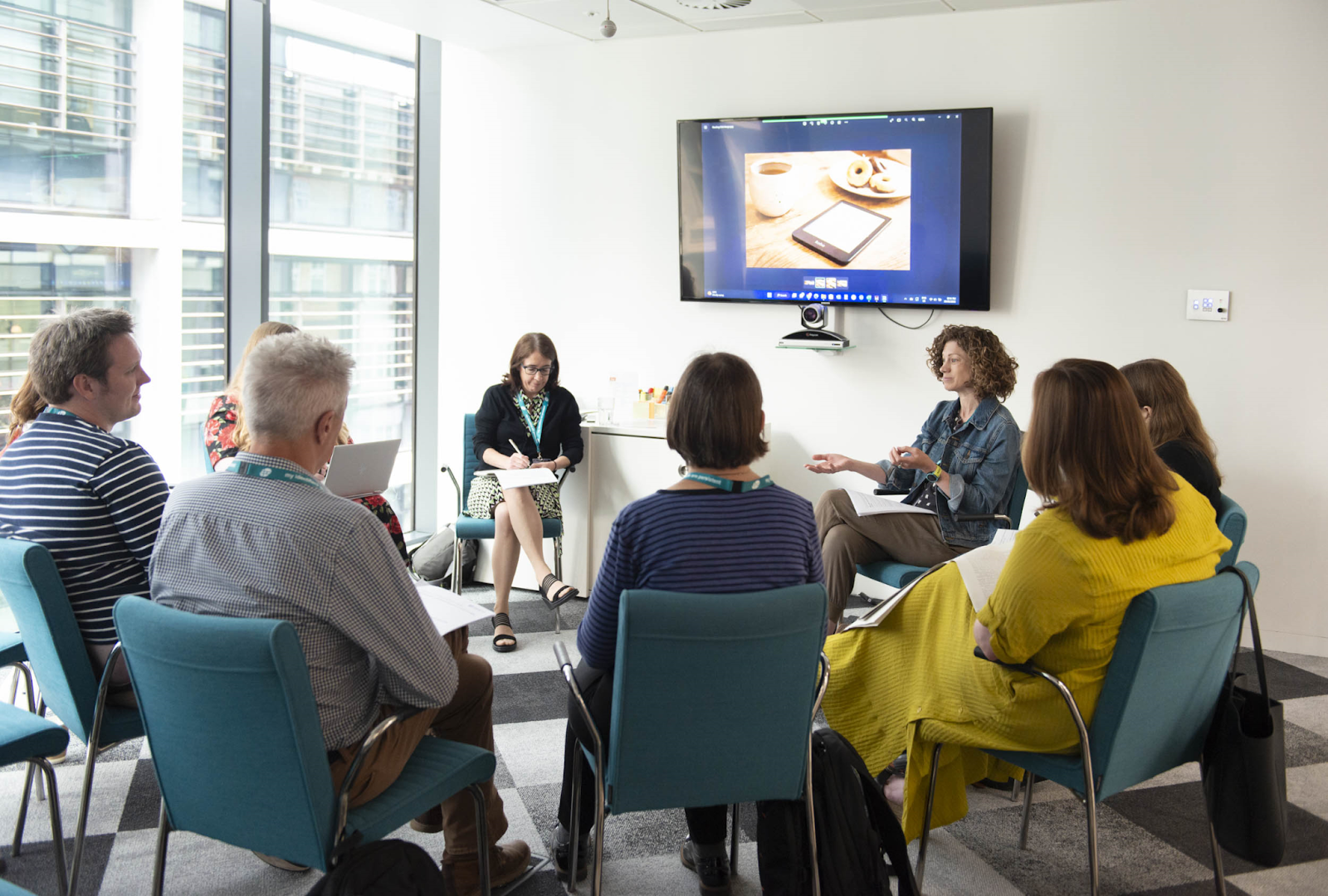
The DPC’s Reading Club provides a forum to chat about a recent digital preservation publication with other Members in a friendly and informal group. Established in 2023, sessions typically run on a monthly basis in a variety of different time zones and cover reading on a range of topics relevant to digital preservation.
Why Reading Club?
Digital preservation is an ever changing discipline, and it can be hard to keep up with new developments and publications relevant to our work. DPC’s Reading Club provides a useful signpost to a recently published article and the opportunity to chat about it informally with your peers. This can be a helpful way of maintaining a connection with current digital preservation literature when in a busy and demanding role with limited time for research. Reading Club could also be considered to be a part of your own Continuous Professional Development.
Come along to an event
Reading Club is open to all DPC Members, but places are limited to enable small group discussion. Keep an eye on our events page and weekly digest email on the DPC-DISCUSSION mailing list to find out what we are reading next and when we will be meeting to discuss it. You don’t have to come along to every session, just join in when it suits you. Most of our Reading Club events are held online.
Suggest something for us to read
We are always happy to receive suggestions of publications to read for these events. Note that we prefer to read articles, book chapters or blog posts that are:
-
Relevant to digital preservation
-
Thought provoking
-
No more than 40 pages in length
-
Freely available for all to access online
-
Recent - i.e. published (or made openly available) in the last three years
Do get in touch with Jenny.Mitcham@dpconline.org with ideas, comments and suggestions.
Reading list
Missed a Reading Club event? Don’t worry, we maintain a list of all the articles and publications we have read below (ordered by event date). Do dive in and catch up on what we’ve been reading in your own time:
-
August 2026: NDSA Levels of Digital Preservation Working Group (2026), "NDSA Levels of Digital Preservation Environmental Sustainability Guide", an NDSA publication, https://osf.io/yv48k/files/9x5ny
- July 2026: Arran J. Rees and Elizabeth Stainforth (2025), "Disentangling Ownership in Digital Collecting Practices: Approaches From Across Galleries, Libraries, Archives, and Museums", Digital Humanities Quarterly (2025) 19 (2). https://doi.org/10.63744/3f9pjv5r6aux
-
June 2026: Laura Rothfritz (2026), Emergency curation as anticipatory maintenance: Lessons from the 2016/2017 data rescue movement, Big Data and Society, February 2026. https://doi.org/10.1177/20539517261421482
-
April 2026: K Murray and J Sternfeld (2026), Content Authenticity and Provenance in the Age of Artificial Intelligence: A Call-to-Action for the LAMs Community. https://drive.google.com/file/d/1VMkNDcY1KBH1YV0QOVGs38o6eetUTddj/view
-
March 2026: Kyle Deeds, Ying-Hsiang Huang, Claire Gong, Shreya Shaji, Alison Yan, Leslie Harka, Samuel J Klein, Shannon Zejiang Shen, Mark Phillips, Trevor Owens, and Benjamin Charles Germain Lee. November 2025. [2511.11010] GovScape: A Public Multimodal Search System for 70 Million Pages of Government PDFs
-
February 2026: Eric Kaltman, Winnie Schwaid-Lindner, Drey Jonathan, Andrew Borman, Alex Garnett, and Larry Masinter. An Overview of Emulation as a Preservation Method. July 2025 https://www.clir.org/pubs/reports/an-overview-of-emulation-as-a-preservation-method/
-
January 2026: Shaw, Seth. 2025. What it Means to be a Repository: Real, Trustworthy, or Mature?. October 2025 https://journal.code4lib.org/articles/18541
-
December 2025: Jones, Stacey, Jay Gattuso, Jaime Schumacher, Kyle Henke, Carol Kussmann, Sam Meister, and Danielle Taylor. 2025. Beyond the Checklist: Healing, Connection, and Capacity-Building Through Digital Preservation Peer Assessment. A white paper prepared for the Institute of Museum and Library Services for the Digital POWRR Peer Assessment Program. July 2025. http://hdl.handle.net/10150/677915
-
October 2025: Boczar, A (2025), Starting with the Digital Doesn’t Make it Easier: Developing Transparent Born Digital Acquisition Policies for Archives , International Journal of Digital Curation Vol. 19 no. 1. https://doi.org/10.2218/ijdc.v19i1.944
-
September 2025: Lehuedé, S 2024 An Elemental Ethics for Artificial Intelligence: Water as Resistance Within AI’s Value Chain , AI & Society: Journal of Knowledge, Culture and Communication, online at https://ssrn.com/abstract=4756794
-
August 2025: Espenschied, D (2024). Emulation. Digital Preservation: A Critical Vocabulary. Retrieved from https://digital-preservation-a-critical-vocabulary.pubpub.org/pub/cqo43abe/release/1
-
July 2025: Arroyo-Ramírez, E., & Fidler, C. V. (2024). Processing. Digital Preservation: A Critical Vocabulary. Retrieved from https://digital-preservation-a-critical-vocabulary.pubpub.org/pub/5fyrimds
-
June 2025: Yakel, E., Faniel, I. M., & Polasek, K. (2024). Trust . Digital Preservation: A Critical Vocabulary. Retrieved from https://digital-preservation-a-critical-vocabulary.pubpub.org/pub/mfby9zaj
-
May 2025: Cochrane, E. (2024). Obsolescence. Digital Preservation: A Critical Vocabulary. Retrieved from https://digital-preservation-a-critical-vocabulary.pubpub.org/pub/ajzjdqk4
-
April 2025: Canning, D., Jaillant, L. (2025) AI to review government records: new work to unlock historically significant digital records. AI & Society. https://doi.org/10.1007/s00146-025-02221-0
-
March 2025: David Pearson and James Doig (2022), "Tales from “THE disK FILES”: Lessons Learnt from a Data Recovery Project in 2003–2006 at the National Archives of Australia", The American Archivist (2022) 85 (2): 359–401. https://doi.org/10.17723/2327-9702-85.2.359
-
February 2025: Max Eckard; Elizabeth Gadelha; Mike Shallcross (2022) "Level Up! Lessons Learned from Six Years of Collaborative Technical Skills Development" The American Archivist 85 (2): 402–442.
https://doi.org/10.17723/2327-9702-85.2.402 -
January 2025: Milligan, Ian. (2024) “Archiving Disaster: The Case of 11 September 2001“ in Averting the Digital Dark Age: How Archivists, Librarians, and Technologists Built the Web a Memory. John Hopkins University Press. https://muse.jhu.edu/pub/1/oa_monograph/chapter/4050591/pdf
-
December 2024: Schaefer, S. (2024), "Energy, Digital Preservation, and the Climate: Proactively Planning for an Uncertain Future", iPRES 2024: https://ipres2024.pubpub.org/pub/1sm257xx/release/2
-
November 2024: Altman, M and Landau, R (2024), "Selecting Efficient and Reliable Preservation Strategies: Modeling Long-term Information Integrity Using Large-scale Hierarchical Discrete Event Simulation". International Journal of Digital Curation, Vol. 18, No. 1 https://doi.org/10.2218/ijdc.v18i1.743
-
October 2024: Frank, R.D. (2024), "Constructing risk in trustworthy digital repositories", Journal of Documentation - open access copy available here: https://deepblue.lib.umich.edu/handle/2027.42/194298
-
September 2024: Dentler, J., Jaillant, L., Foliard, D. and Schuh, J., 'Sensitivity and Access: Unlocking the Colonial Visual Archive with Machine Learning' Digital Humanities Quarterly, Volume 18, Number 3 (July 2024) https://www.digitalhumanities.org/dhq/vol/18/2/000742/000742.html
-
August 2024: Andrews, N. IT’S NOT IMPOSTER SYNDROME: RESISTING SELF-DOUBT AS NORMAL FOR LIBRARY WORKERS, In the Library with the Lead Pipe (June 2020) https://www.inthelibrarywiththeleadpipe.org/2020/its-not-imposter-syndrome/
-
July 2024: Owens, T (2024). After Disruption: A Future for Cultural Memory, University of Michigan Press, 2024. https://doi.org/10.3998/mpub.12410213 (Chapter 3 - ‘Where Data Drives’ pp.43-78).
-
June 2024: Vaarzon-Morel, P., Barwick, L., & Green, J. (2021). Sharing and storing digital cultural records in Central Australian Indigenous communities. New Media & Society, 23(4), 692-714. https://doi.org/10.1177/1461444820954201
-
May 2024: Déirdre Joyce; Laurel McPhee; Rita Johnston; Julia Corrin; Rebecca Hirsch (2022), "Toward a Conceptual Framework for Technical Debt in Archives", The American Archivist 85 (1), 104 - 125, https://doi.org/10.17723/2327-9702-85.1.104
-
April 2024: British Library cyber incident review paper (2024), https://www.bl.uk/home/british-library-cyber-incident-review-8-march-2024.pdf.
-
March 2024: Lise Jaillant and Katherine Aske, (2024), "Are Users of Digital Archives Ready for the AI Era? Obstacles to the Application of Computational Research Methods and New Opportunities", Journal on Computing and Cultural Heritage (Volume 16 Issue 4), https://doi.org/10.1145/3631125
-
February 2024: Sam Alloing (2023), "MONITORING FILE FORMAT OBSOLESCENCE IN REPOSITORIES: An applied method", iPres 2023 https://hdl.handle.net/2142/121117
-
January 2024: Daniel Steinmeier (2023), "BE CAREFUL WHAT YOU CAMPAIGN FOR: How formal organization practice may negatively impact adaptability aspects of preservation", iPres 2023 https://hdl.handle.net/2142/121088
-
December 2023: Sophia van Hoek (2023), "Walking a tightrope across the gap of digital preservation and environmental sustainability: The National Archives of the Netherlands and the challenge of achieving a climate-neutral digital archive", https://kia.pleio.nl/attachment/entity/931f65cb-2058-4fe9-a500-99bc53dfde40
-
November 2023: Kieran Hegarty (2022), "Representing Biases, Inequalities and Silences in National Web Archives: Social, Material and Technical Dimensions", Archives & Manuscripts, 50(1) https://doi.org/10.37683/asa.v50.10209
-
October 2023: James Cummings (2023), "Academics Retire and Servers Die: Adventures in the Hosting and Storage of Digital Humanities Projects", Digital Humanities Quarterly, Vol 17 No 2. http://digitalhumanities.org/dhq/vol/17/1/000669/000669.html
-
September 2023: Venkata, S. K., Young, P., Bell, M. and Green, A. (2021), "Alexa, is this a historical record?", Journal of computing and cultural heritage, Vol. 15 Issue 1, Available from https://www.nationalarchives.gov.uk/about/our-research-and-academic-collaboration/our-research-projects/open-access-research-from-our-staff/alexa-is-this-a-historical-record/
-
August 2023: Anderson, T., Colón, R.D., Goben, A. and Karcher, S. (2022), "Curating for Accessibility", International Journal of Digital Curation, Vol. 17 No. 1, http://www.ijdc.net/article/view/837
-
July 2023: Cushing, A.L. and Osti, G. (2023), "“So how do we balance all of these needs?”: how the concept of AI technology impacts digital archival expertise", Journal of Documentation, Vol. 79 No. 7, pp. 12-29. https://doi.org/10.1108/JD-08-2022-0170 (read a blog post about this Reading Club session here)
-
June 2023: Jaillant, L. (2022) “More Data, Less Process: A User-Centered Approach to Email and Born-Digital Archives” The American Archivist Vol. 85, Issue 2. Available at https://repository.lboro.ac.uk/articles/journal_contribution/More_data_less_process_a_user-centered_approach_to_email_and_born-digital_archives/16560135
-
May 2023: Monique Lassere and Jess M. Whyte (2021), Balancing Care and Authenticity in Digital Collections: A Radical Empathy Approach to Working with Disk Images, Journal of Critical Library and Information Studies (2021) https://doi.org/10.24242/jclis.v3i2.125 (read a blog post about this Reading Club session here)
-
April 2023: Thorsten Ries (2022), Digital history and born-digital archives: the importance of forensic methods, Journal of the British Academy, volume 10: https://doi.org/10.5871/jba/010.157 (read a blog post about this Reading Club session here)
Find all the Reading Club blog posts here.
Python Study Group Program


The Python Study Group Program
Effective digital preservation needs ongoing, continuous development of various skills. In particular, scripting and coding skills are necessary to effectively support and develop digital preservation tasks and workflows. Despite this recognized need, digital preservation practitioners often describe this as a gap in their skillset and point to difficulties to identify relevant training opportunities for developing these skills to the extent that they can be practically and meaningfully used.
The main purpose of the BitCurator Consortium (BCC) and Digital Preservation Coalition (DPC) Python Study Group (PSG) program is to provide a regular and effective training program and community of peer-to-peer learning focused on developing scripting and coding skills that can be practically and meaningfully applied to digital preservation activities and workflows.
The main aims of the program are to:
-
Support the community
-
Develop skills
-
Build capacity
-
Collaborate
The Python Study Group Launch and Information Session took place in October 2023 (recording available below).
The first study groups began in January 2024, meeting on a monthly basis over a six-month period. The second cycle followed, with groups meeting from July to December 2024.
The Python Study Group program is currently on hiatus to review impact and viability, with the evaluation of the program overseen by the PSG Governance Group.
How can I get involved?
The Python Study Groups welcome participation from BCC and DPC members as well as the broader digital preservation community.
However, to keep numbers manageable, there are a finite number of places in the study groups. There will be priority places set aside for DPC and BCC members as well as a limited number of places for those who are not currently members of these organizations (see Python Study Group Terms of Reference ).
Please note that the study groups are currently on hiatus.
Program Mentors and Governance Group Members
There are different ways to participate in the Python Study Groups Program! You can join one of the study groups as a participant, or help form the program by becoming a Governance Group Member. We are also actively seeking Program Mentors to help support study groups.
Read more about the different roles.
Terms of Reference
Python Study Group Terms of Reference
____________________________________________________________________________
|
|
About the BCC The BitCurator Consortium (BCC) is an independent, community-led membership association that promotes sustainable curation of born-digital materials by any organization responsible for caring for such materials. The Consortium is building a community of organizations that support practitioners responsible for digital archiving and preservation work, especially through the application of free and open-source tools. Activity is conducted remotely and membership is open to all. |
|
|
About the DPC The DPC is an international charitable foundation which supports digital preservation, helping its members around the world to deliver resilient long-term access to digital content and services through community engagement, targeted advocacy work, training and workforce development, capacity building, good practice and standards, and through good management and governance. Its vision is a secure digital legacy. |
Career Development Fund: Travel Grants for iPres 2022
The DPC is pleased to announce it is offering ten Career Development Fund (CDF) travel grants to support DPC Members attending the iPres 2022 conference taking place in Glasgow, Scotland, 12th-16th September 2022. These grants will contribute funding to help with the costs of travel and accommodation for DPC Members attending the conference in-person. Details of the grants are provided below.
iPres 2022: Supported Registrations from the DPC
2022 is the twentieth anniversary of the founding of the DPC. To mark this, the DPC is sponsoring participation in iPres for its entire membership around the world.
The Executive Board has set aside funds to meet the registration fee for one in-person conference delegate from every DPC member. This unique offer is designed to ensure a wide representation of the DPC community at the conference, especially by those who would not otherwise be able to participate. This offer is made in good faith to add value and expanding participation. It should not substitute existing budgets. Where in-person attendance is impossible, online attendance can be substituted.
CDF Grant Recipients
Find out more about the benefits of the DPC Career Development Fund from previous grant recipients...
The following blog posts and outputs from previous DPC grant recipients, arranged by the name of the event or course, provide information and reflections on the knowledge or skills learned from the funded opportunity.
Aberystwyth University Department of Information Studies (DIS) Short Courses
Archives and Records Association (ARA) UK & Ireland Annual Conference
- Rosie Dyson (2024): Sustainable approaches to digital preservation at ARA2024
- Janina Ziesche (2021): Marketing Records Management and Digital Preservation – Approaches to Advocacy at the ARA 2021 Virtual Conference
- Jessica Hooley (2021): Reflecting on the ARA 2021 Conference as an Archives & Records Management Student
Australian Museum and Gallery Association’s (AMaGA) Conference
- Liz Long (2023): Leaning into discomfort at AMaGA 2023
Australian Society of Archivists (ASA) Annual Conference
- Giorgia Gakas (2025): Telling Our Stories: Community. Connection. Resilience
- Joyce Wong (2023): Rising to our Challenges as a Community - ASA 2023
- Natalie Anderson (2022): ASA 2022 - NFSA: Evolving Identity and Emerging Technologies
- Andrea Walker (2021): The ASA 2021 Conference: Some Reflections and Highlights from a Virtual Attendee
Birkbeck University of London Certificate in Applied Data Science
- Erin Liu (2025): Targeted automation for pre-ingest workflows at the UAL Archives and Special Collections Centre
- Jake Bickford (2021): Providing computational access to the Polytechnic Magazine (1879 to 1960)
Digital Preservation Training Programme (DPTP) and DPTP Online Course
- Rachael Muir (2019): Reflections on the Digital Preservation Training Programme
- Chris Loftus (2017): DPTP Migration of file formats; understanding loss and how to manage it
- Short interviews with 2011 grant recipients who attended the Digital Preservation Training Programme
Discovering Collections, Discovering Communities (DCDC) Conference
- Emma Burgham (2023): DCDC 2023 – Radical Reimagining
- Adrian Clark (2022): DCDC 2022 - Inclusive, Diverse, Collections for the Future - now!
- Yi-Ting Lin (2022): DCDC 2022 - The Future Landscape of Digital Archives
- Shalen Fu (2021): DCDC21: Transforming crisis into opportunity within the GLAMA sectors
- Carrie Marks (2021): Digital Loans and Virtual Visitors
Fédération Internationale des Archives du Film (FIAF) Film Restoration Summer School
- Natalia Bianchi (2022): Notes After Attending the 2022 FIAF Film Restoration Summer School
Fédération Internationale des Archives de Télévision / The International Federation of Television Archives (FIAT/IFTA) World Conference
- Thandokazi Maceba (2022): Reimagining the digital preservation workflows of Archives - FIAT/IFTA World Conference 2022
Information and Records Management Society (IRMS) Conference
- Bridie-Ann Carr (2023): IRMS2023 Conference – Digital preservation dreams and the shared drive nightmare
International Conference on Digital Preservation (iPRES)
- Ruby L Martinez (2025): 14 Things I Loved and Learned at iPRES 2025
- Sally O'Callaghan (2025): The Data Recovery of it all: iPRES 2025
- Lukas Hechenblaickner (2024): iPRES 2024 - Meeting the Digital Preservation Community - Impressions of a first-time attendee
- Delaney Sweep (2024): The Difficulty with Art: Reflections on the iPRES 2024 session “Preserving Works of Art”
- Taryn Ellis (2023): Musings on the iPres 2023 Panel, “Policies, Risks and Strategies: A File Format Debate”
- Emily Clarke (2023): WDPD, iPRES 2023 and Digital Preservation: A Concerted Effort
- Ailie O'Hagan (2023): Digital Preservation Soup
- Elisabeth Thurlow (2019): iPres 2019: Making Emulation Accessible and iPres 2019: Preserving the people in digital preservation
- Elizabeth Kata (2019): Finding the Cutting Edge in Common Formats
- Leontien Talboom (2019): iPres 2019 session - NEW HORIZONS // Web Archiving and iPres 2019 session - NEW HORIZONS // Access & FAIR
- Kirsty Fairclough (2019): iPRES 2019 // Whose Digital Preservation? Locating our Standpoints to Reallocate Resources and iPRES2019 // Sad by Design: Politics and Psychology of the Social Media Age
- John Pelan (2019): iPres 2019: A roundup
- Jaana Pinnick (2019): iPres 2019 New Horizons Panel – Sustaining Digital Preservation in the Nuclear Field
- Colin Armstrong (2018): Taking Stock after 15 years Panel at iPres 2018 and Web Preservation at iPRES 2018
- Alexander Roberts (2018): Variation in national digital preservation policies and The 'Capstone' email appraisal approach
- Chris Fryer (2017): Data management at iPRES 2017
- Jaye Weatherburn (2017): Preservation storage workshop at iPres 2017 and Acquisition and Appraisal at iPres2017
- Louise Lawson (2017): Emulation and Software Preservation at iPres 2017 and FAIR Data in Trustworthy Data Repositories at iPres 2017
- Paul Young (2016): iPRES 2016 Blog - Panel: Software Sustainability and Preservation
International Conference on FAIR Digital Objects (FDO)
- Zoë Hollingworth (2022): FAIR Digital Objects 2022 Conference – Challenges with terminology
- Louise Preston (2022): FDO2022 Conference – human and social factors in data and metadata management
International Digital Curation Conference (IDCC)
- Michael O'Connor (2026): What Happens in Zagreb … Gets Shared as Open Data: 10 Takeaways from IDCC26
- Zoe Warner (2022): IDCC 2022 - Digital Preservation and Reuse: You can’t have one without the other
- Thandokazi Maceba (2021): IDCC21/RDAVP17: An out of this world data curation and digital preservation experience
- Iram Safdar (2021): IDCC21 Keynote: Indigenous Sovereignty of Language Data – The Mãori Example
- Evanthia Samaras (2021): An eye-opening opportunity: Report from the 16th International Digital Curation Conference
- Alexandra Mitchell (2020): IDCC Keynote: The Internet of Things and IDCC Session: Selecting efficient and reliable preservation strategies
- Hannah Smith (2020): IDCC 2020 Dublin - ‘Identifying Opportunities for Collective Curation During Archaeological Excavations' and IDCC Session: ‘Long-term data preservation data lifecycle, standardisation process, implementation and lessons learned’, Iolanda Maggio
- Judith Carr (2020): IDCC 2020: Becoming the ‘new normal’ is a good thing, but it is going to take time and IDCC 2020: Do we need to agree on how to say potato
- Clare Mulhall (2018): Notes from IDCC 2018 - Day One and Notes from IDCC 2018 - Day Two
- Odile Dumbleton (2017): International Digital Curation Conference 2017 Edinburgh
International Image Interoperability Framework (IIIF) Annual Conference
- Sebastiaan Schoonebeek (2025): A Snapshot of IIIF 2025: Key Takeaways from the Annual Conference
International Internet Preservation Consortium (IIPC) Web Archiving Conference (WAC)
- Ndahambelela Hertha Iipinge (2024): Reflections on my first IIPC WAC, Paris 2024
- Barbara Fuentes (2023): IIPCWAC23 – The ’Crème de la Crème of’ Web Archiving work
- Dorota Minkiewicz (2023): Where long-term preservation and web archives meet - IIPC WAC 2023
No Time To Wait Symposium Conference, MediaArea
- Maryna Chernyavska (2025): No Time To Wait! in Dublin
- Richard Moores (2024): Notes on obsolescence, travelling to ‘No Time To Wait 8’ in Karlsrühe
- Elizabeth Thompson-MacRae (2024): Future Present, Future Past – NTTW8 in Karlsruhe
- Mzodidi Tutuka (2023): Exploring the Frontiers of Digital Preservation: Insights from the NTTW7 Conference in Prague
- Nigel Bryant (2022): Tapping the (Open) Source – No Time To Wait 2022
Northeast Document Conservation Center (NEDCC) Digital Directions Conference
- Amy Ibbotson (2023): Digital Directions – providing direction and reflection
- Angélique Bonamy (2023): Take-aways from NEDCC Digital Directions 2023: Inclusive online training for anyone working with digital collections
- Mzodidi Tutuka (2022): Reflections Following an Online Training Conference: 2022 NEDCC Digital Directions
- Ruth Schieferstein (2022): Digital Directions: Insights from a Virtual Conference
- Fabi Barticioti (2022): Digital Directions: A whistle stop into the NEDCC's annual conference
- Megan Joyce (2020): NEDCC Digital Directions Conference 2020 – “Digital preservation is technology enabled but human driven”
Preservation and Archiving Special Interest Group (PASIG) Conference
- Rachel Tropea (2019): PASIG 2019, 12-14 Feb, El Colegio de México, Mexico City (part 1) and PASIG 2019, 12-14 Feb, El Colegio de México, Mexico City (part 2)
- Matthew Zawadzki (2017): Reflections on PASIG 2017, Oxford
- Simon Whibley (2017): PASIG 2017 - A Twitter Retelling
PV Ensuring long-term Preservation and Adding Value to Scientific and Technical Data Conference
- Nick Bywell (2023): PV2023 Conference - Notes on the preservation and dissemination of data created by the Large Hadron Collider (LHC) at CERN
Research Data Management Forum (RDMF), Digital Curation Centre
- Fatima Darries (2021): Reporting on RDMF21: Data Stewardship in Research Institutions
Society for Imaging Science and Technology (IS&T) Archiving Conference
- Geoffrey Schilling (2025): Exploring Non-Traditional Imaging at IS&T Archiving 2025
- Paul Shields (2023): IS&T Archiving 2023 – Notes on two emerging imaging and archiving threads
- Gemma Evans (2022): Reflections on Imaging, Visualisation and Artificial Intelligence from the IS&T Archiving 2022 Conference
- Caroline Lebre (2021): Back to basics at IS&T Archiving 2021: Tailoring Quality Assurance Workflows to your Digitisation Project
- Annette Le Roux (2021): Reflections on Operation Night Watch: the largest research and conservation project of one of Rembrandt’s finest works
Winter School for Audio-visual Archiving, Netherlands Institute for Sound & Vision
- Ivan Dimitrovski (2020): Winter School for Audio-Visual Archiving 2020
- Sally Cholewa (2020): A day in the life of a Winter School for Audio-visual Archiving participant
Digital Futures Academy
Call for Contributions!
Previous DPC Career Development Fund (and Leadership Programme) recipients are invited to share what they learned from past funded opportunities. If you would like to share any relevant outputs (e.g. blog posts, case studies, reports) to add to this page, please email DPC Training & Grants Manager, Amy Currie, amy.currie[at]dpconline.org
Acknowledgements
The Career Development Fund is sponsored by the DPC’s Supporters, who recognize the benefit and seek to support a connected and trained digital preservation workforce. We gratefully acknowledge their financial support of this programme and ask applicants to acknowledge that support in any communications that result. At the time of writing, the Career Development Fund is supported by Arkivum, Artefactual Systems Inc., boxxe, Cerabyte, DAMsmart, Evolved Binary, Ex Libris, HoloMem, Iron Mountain, Libnova, Max Communications, Pictoscope, Preferred Media, Preservica and Simon P Wilson. A full list of supporters is online here.
|
|
 |
|
|
|
 |
 |
|
|
 |
 |
|
|
 |
 |
 |
 |
 |