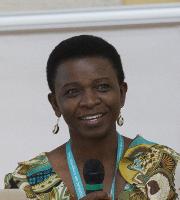
Angeline Takawira-Magaya is Digital Archivist at the International Residual Mechanism for Criminal Tribunals (IRMCT).
The archives of the International Criminal Tribunal for the former Yugoslavia (ICTY), the International Criminal Tribunal for Rwanda (ICTR) and the International Residual Mechanism for Criminal Tribunals (IRMCT) are often described as repositories of evidence, court records and judicial decisions. What is often overlooked is that they are also a collection of human voices and stories. They include voices of survivors recalling what they endured; witnesses recounting the horrors that they saw and heard; judges grappling with difficult questions of law and fact; prosecutors piecing together evidence of atrocities committed during the conflicts; and accused persons responding to allegations.
For World Digital Preservation Day 2026, under the theme "Save Our Stories: Our Digital Heritage in Danger," we reflected on the many voices contained in the tribunals’ archives and on the preservation work required to ensure accessibility and usability so that they continue to speak to future generations.
The Tribunal archives[1]
In their more than 30 years of operation, the tribunals generated approximately 3 petabytes of born-digital and digitized records comprising millions of files which include judicial case documents, witness statements, audiovisual recordings of court proceedings, photographs, maps, databases, websites and more in a variety of formats – to date over 80 formats (PUIDs) have been identified. Together, these archives are a unique testament of how the international community sought to establish accountability after mass atrocities. Yet behind every file lies a human story.
The stories
The victims and witnesses
More than 4,650 witnesses testified before the ICTY and 2,200 before the ICTR. Their testimonies provide first-hand accounts of events as seen, heard and experienced by every corner of society. Survivors described attacks on their communities. Former detainees recounted life inside detention facilities. Family members spoke of loved ones who never returned. Military insiders explained command structures and operational decisions. Investigators, doctors and forensic experts helped reconstruct events through professional evidence and analysis. Together, these testimonies document killings, persecution, sexual violence, forced displacement, torture and the destruction of communities. They also tell of extraordinary resilience, courage and determination. These stories are preserved in witness statements, exhibits, transcripts and thousands of hours of audiovisual recordings. Their preservation ensures protection of their experiences from denial or distortion so that future generations can hear what happened and how it affected the people who lived through them by listening to testimonies recorded in witnesses’ own voices and languages.
The accused
While the victims and witnesses tell one part of the story, the accused tell another. The archives preserve the stories of two hundred and fifty-four (254) individuals who were indicted by the ICTY (161) and ICTR (93). These individuals include political leaders, military commanders, government officials, media figures and direct perpetrators accused of serious violations of international humanitarian law. Some denied responsibility. Some challenged the charges for years. Some were acquitted. Many more were convicted. A small number admitted their crimes and accepted responsibility. Their collective and individual stories are documented in indictments, court filings, transcripts, judgements and video recordings of court proceedings. These records are not merely legal documents. They reveal how individuals explained, defended or reflected upon their actions.
The people behind international justice
The archives also preserve the voices of the many people who worked to establish accountability.
Over the course of three decades, the legal reasoning through judgements, separate opinions and dissenting opinions of one hundred (100) international judges was documented – helping to shape modern international criminal law. More than seven (7) Chief prosecutors and their teams of investigators, lawyers and analysts carefully pieced together evidence, in the aftermath of conflict and destruction, creating compelling cases for trial. Defence teams put forth arguments aimed at protecting the rights of the accused, as well as ensuring fair trials. In the courtrooms and beyond, eleven (11) Registrars and their teams of lawyers, interpreters, translators, witness protection and support officers, psycho-social experts, detention facility staff, court reporters, information managers, technology experts, audiovisual technicians and administrative staff kept the institutions functioning. Their individual and collective stories reveal the immense human efforts required to transform evidence into accountability and justice for victims. The reports, administrative records, speeches, audiovisual materials and institutional publications which they generated in the conduct of their work are preserved in the archives and will provide benchmarks and lessons learned for future generations.
Preserving the stories
Current responsibility for preserving these stories rests with the IRMCT's Archives and Records Section (MARS). For MARS, digital preservation is about ensuring that the voices and stories contained within the archives remain accessible, authentic and understandable for generations to come. To this end we have been actively safeguarding these collections against technological obsolescence, media degradation and related threats. Many of the testimonies were recorded on analogue audiovisual formats for which playback equipment is quickly vanishing from the market. Other records were stored on technologies such as floppy disks, CDs and DVDs which have become obsolete. To ensure that these voices are not lost, MARS has digitized almost all analogue audiovisual recordings in the archival collection. It actively migrates records from vulnerable media into secure preservation environments with the migration of hundreds of thousands of documents from more than 3,000 CDs, DVDs and floppy disks, over the last year alone. Furthermore, over 428 terabytes of archival material have been ingested into a dedicated digital preservation system where they are continuously monitored for corruption or format obsolescence and preservation actions (e.g. format migration) are undertaken as required.
Threats to the stories
While the Mechanism is taking necessary steps to ensure preservation, the stories preserved in the archives still face many threats. First, are technological threats which, as we know, do not have ‘fixes’ that can be applied ‘once and for all time’. Technologies will continue to evolve, storage media will degrade, file formats will become obsolete, software and hardware platforms will disappear, human error and cyber incidents will continue to be a reality. Active interventions, to mitigate these threats, will be required perpetually to ensure that these stories remain accessible despite these challenges.
This brings us to the next challenge, active preservation in perpetuity, depends on sustained institutional commitment, specialist expertise and continued financial investment.
Historical denial, revisionism and the distortion of established facts continue to challenge societies around the world and artificial intelligence has further eroded the reliability of what people see, hear, and read, making it critical to authenticate original sources. These challenges cannot be addressed by archivists alone.
"Save Our Stories" is therefore also a call to action. Preserving the tribunals’ stories does not only require archivists and digital preservation professionals, but is a collective responsibility involving governments of United Nations member states, societal institutions, donors and funders to provide sustained funding and researchers, educators, journalists and the general public to use and engage with the historical records because stories that are preserved but not used remain vulnerable to being forgotten.
[1] Details about the tribunals and the archival collections are not repeated as they are in an earlier blog item see https://www.dpconline.org/blog/digipres-at-unmict