





























































































































Understand your content
Use this to document what content you have and where it is stored.
|
|
|
|
Choose/Create your content
Use this to decide what you will collect and identify where it will come from.
|
|
|
|
What Next? Resource List
 |
This toolkit has provided a series of basic practical guidance to get you started on your digital preservation journey. If you would like to learn more about a particular topic or build on the processes you have already put in place, the resource list below is a good place to start. It has been split into the toolkit topic sessions for ease of searching. |
General Guides - The resources here give an overview of a range of digital preservation tasks
|
Novice to Know How – Digital Preservation Coalition |
Novice to Know How is an online digital preservation training basics course. The course covers basic digital preservation policy and procedure and gives guided demos of some software options. |
|
Tech Watch Reports and Guidance Notes – Digital Preservation Coalition |
These are a series of reports and guidance notes on a wide range of digital preservation topics. They are in depth and can be quite technical in language and topics covered. |
|
Digital Preservation Handbook – Digital Preservation Coalition |
The Digital Preservation handbook is a how- to guide for all things digital preservation. |
|
COPTR helps practitioners find tools needed for long term digital preservation tasks. It describes 611 tools and 36 workflows. |
|
|
Specific area of COPTR where practitioners upload their workflows for others to see and learn from or implement in their own groups. |
|
|
Digital Repository of Ireland Guide to archiving digital records for volunteer and community groups |
Guide for volunteer, grassroots and community groups, created to assist them with cataloguing and preserving their digital records. |
Choose/ Create Your Content
|
Guidance on how to select the content that will form your digital collections. |
|
|
The National Archive UK Suggested Collecting Policy Elements |
Guidance on possible elements that you may want to include in your collecting policy. |
Organise Your Content
|
Guidance and examples relating to how to name your files. |
|
|
Simple explanation of how archival hierarchies are used. |
|
|
Information and examples relating to archival hierarchies and levels of description. |
Who Does What
|
Toolkit to help you create a digital preservation policy. |
|
|
Toolkit with practical advice and guidance on how to make sure all group members are well trained to do the role they are doing. |
Understand Your Content
|
Digital Preservation Coalition Digital Asset Register Training |
In dept training focused on why you should and how to create a digital asset register. |
|
The complete standard and information about Dublin Core, the file information standard used in level 2 of this topic. |
|
|
A tutorial showing you how to use DROID. DROID is a file identification tool that provides you with information about your files that you can transfer into your digital asset register. It is easy to install and use. |
Keep Your Content
|
Guidance on storage and how to transfer your content to a new storage medium safely. |
|
|
Scottish Council on Archives Getting Started with Fixity Pro |
A tutorial showing you how to use Fixity Pro. Fixity Pro is explained in level 3 of this topic. |
Control Your Content
|
The National Digital Stewardship Alliance (NDSA) Good Migrations Checklist |
A list of things to do and issues to consider when moving digital materials and metadata to new digital preservation systems. |
|
Toolkit providing practical advice on guidance on the steps to take when looking at new software systems. |
Make Copies
|
Tutorial showing you how to use Teracopy. Teracopy is a tool which allows you to safely make and transfer copies of your digital collections. |
Plan to Share
|
A range of easy-to-understand resources about Copyright. A good place for beginners to start. |
|
|
Chartered Institute of Library and Information Professionals (CILIP) Copyright Training |
A range of resources focused on Copyright |
|
UK Information Commissioners Office GDPR Guidance and Resources |
Up to date advice and resources to help you navigate GDPR regulations and sensitive data sharing. |
|
Advice on licensing your created content so it can be shared and with no restrictions. |
Preserve Your Website
|
User Guide for ArchiveWeb browser extension from level 3 of this topic |
|
|
User guide for the software required to play the files created using ArchiveWeb outside the browser extension (once the files are downloaded). |
|
|
A guide to creating web pages which are easier to archive using web archiving methods. |
|
|
An online tool which evaluates if a website will be archived correctly by web archives, such as the Internet Archive. |
Safeguard Your Content
|
The National Digital Stewardship Alliance (NDSA) Levels of Digital Preservation |
Technical matrix which describes different levels of preserving digital content. |
|
Comic strip that gives advice about creating passwords. |
|
|
Model that allows you to benchmark your progress across a range of digital preservation topics. Level up with RAM contains a range of useful resources related to all of the topics in this toolkit. |
Jargon Buster
Glossary
Digital Collection |
The digital content held by your group. More than one digital file relating to the same topic is a digital collection. |
Digital Content |
Digital content is any digital file, record or item held by your group in a digital format |
Lifecycle |
The stages a record goes through when it is being processed for long term use and access. |
Metadata |
Information about the digital content you hold. Also known as data about data. |
Storage Medium |
The place your digital content is stored on. This could range from a laptop or PC, to a USB stick or SD card, to a cassette tape or cloud storage. |
Web Archiving |
The action of preserving webpages from the internet. |
The Internet Archive |
The Internet Archive is a non-profit organization that provides free access to a digital library of cultural artifacts and historical collections. |
UK Internet Archive |
UK based web archiving programme run by the British Library. |
ArchiveWeb |
A web archiving programme that can be used from within a google chrome web browser. |
Web Crawl |
The act of browsing the web automatically and methodically to index or download content and other data from the web. The software to do this is often called a web crawler. |
Copyright |
Copyright is a type of intellectual property that gives the creator of an original work the right to control who can copy or share it. |
A fuller glossary of digital preservation terms can be found at https://www.dpconline.org/handbook/glossary
Acronyms
DPC |
Digital Preservation Coalition. A UK and Ireland based organisation active in digital preservation and responsible for the Digital Preservation Toolkit for Community Archives. |
DPC RAM |
Digital Preservation Coalition - Rapid Assessment Model - A digital preservation maturity modelling tool that has been designed to enable rapid benchmarking of an organization’s digital preservation capability and facilitate continuous improvement over time. |
DAR |
Digital Asset Register - A DAR is a tool for gathering information about digital content to support an understanding of the digital content held by an organization, and to facilitate efficient management of its preservation. |
GDPR |
General Data Protection Regulation - A law that governs how personal data of individuals in the European Union (EU) is processed and transferred. The GDPR is considered the world's strongest privacy and security law. |
NDSA |
The National Digital Stewardship Alliance (NDSA) is an international organization that works to preserve digital heritage. |
OHOS |
Our Heritage, Our Stories - Towards a National Collection spoke project focused on the landscape and fragiliy of community archives and their digital content. This toolkit was created as part of the OHOS project. |
TNA |
The National Archive of the UK. |
Digital Preservation – Just One Thing
Choose / Create Your Content – Level 1
Whether you are just starting to think about creating a collection, or you already have digital content in your care, documenting what you are collecting will make it clear what you want to collect and where you will get the content from.
This will be useful to point to if you are offered content that doesn’t fit with the rest of the collections you hold. It will also help you to identify any gaps that you may want to fill. Identifying where your collections have come from will help with future processing work and give you somewhere to start if you want to collect more records in the future.
The most common way to document what you collect is by creating a collecting policy. A collecting policy aims to set out your principles and criteria for selecting and acquiring collections. A good policy doesn't need to be too lengthy or detailed, as long the statements in it are clear.
Just One Thing
Write a one paragraph collecting policy that states what you will and won’t collect. Make it available to everyone who works with your collections to help you to streamline your collecting process and ensure you only collect the records that fit with your organisation's remit.
This collecting policy template will help you get started.
Next Steps
Creating a more detailed collecting policy will allow you to expand on the type of records you collect, in what format, and why you have made these decisions. The next level will show you what you should be thinking about and how to use your audience to inform the decisions you make about what to collect.
Organise Your Content – Level 1
Naming files is important, not only so you can find them again, but also so anyone accessing the records can easily find what they are looking for.
How you name your files will depend on the content you have, but in general, file names should be as short as possible while clearly identifying the record. You can also include dates in the file name if this is useful but use the same date format for very record (for example 28112012 or 28th Nov 2012).
Just One Thing
Decide how you want to name your files and use this method to name every digital file you collect. Write down the method you have chosen and make everyone who will be naming records aware.
This document contains advice about deciding on and implementing name and date conventions.
Next Steps
Naming all your files in a similar style is the first step of using Naming Conventions. Level two will take this one step further and provide details on how to structure your files to make them more accessible.
Who Does What – Level 1
Have clear roles and responsibilities
It’s essential to have clear roles and responsibilities when working with digital content. By agreeing and documenting the roles and responsibilities within your community group, you can avoid duplicating work, enhance teamwork and effectiveness, and (perhaps most importantly) ensure that any critical activities are always addressed. Staff or volunteers will come and go, and it is important that key responsibilities are understood by all and passed on to someone who can continue to carry them out.
Community groups have historically been good at ensuring some of these key roles are addressed. For example, having a chairperson to give overall leadership and direction or having a Treasurer to ensure someone is responsible for managing finances. In the digital age, there are new and critical responsibilities that should be addressed. These include:
-
Performing backups of digital collections
-
Paying for website hosting
-
Ensuring documentation is up to date
-
Making sure cybersecurity is addressed
Just One Thing
Simply document your key tasks, and who is responsible for them. This is a powerful way of managing the effectiveness of your group over time.
This template will help you to do this.
Next steps…
An annual review of roles can ensure that this information remains up to date, relevant and effective. The next level provides a more detailed guide to managing your group’s responsibilities, knowledge and skills.
Understand Your Content – Level 1
What do you have and where is it?
Knowing what records make up your collection and where they are is one of the most important steps you can take when working with digital records.
Having a list of the content you have and where you can find it will help you efficiently and effectively process your records and save you time. Making sure that everyone who works with your collections also has access to this information is an important step in preserving your content long term.
Just One Thing
Create a simple list that contains the title of the collection, what medium the collection is stored on (server, cloud, external hard drive, laptop etc) and the file path to direct you to the content. This is the minimum required to allow you to start working on preserving your files. Ensure this list is available to everyone who will be working with your content.
A spreadsheet is an ideal format for capturing this information as it makes it easy to search and filter. This template will help you get started.
Next Steps
The information you have listed so far is basic metadata. Metadata is the information you have about the content you collect (metadata means data about data). The more metadata you collect, the more informed about your collections you will be. Level 2 looks at other important metadata you can collect about your content and why.
Keep Your Content – Level 1
Storage Review
All technology has a shelf life, and this includes the medium or devices that your content is stored on. For example, external hard drives tend to have around a five-year life span and cloud storage will only be accessible as long as the bill is paid.
Removable media, such as CDs and DVDs, can be easily lost or damaged. Hard disk drives can malfunction or break. Legacy storage media, such as floppy disks, may not be supported by contemporary computer environments.
Just One Thing
Check that your current storage media for all your content is still accessible and functioning properly. Bear in mind that storage media can sometimes fail suddenly and unexpectedly. Replace or upgrade as needed to ensure your content stays accessible. Replacing storage before you have issues accessing content will save both time and money in the future. This includes making sure that payment for any cloud or off-site storage is up to date and those involved know what they need to do to keep it active.
Use this template to keep track of the storage you have and any changes you make.
Next Steps
Working with the current storage you have is a good first step but carrying out a review of available storage options will help you find out if a more suitable option is available. The next level will give details about the options you have and help you identify the best option for your set up.
Control Your Content - Level 1
Exit Strategy
Having your digital collections locked into a particular system, app, service, or website can be a huge risk. Especially if that system or service is closed down, or you simply want to move it elsewhere.
A common example is the use of Facebook groups by community organizations. They are relatively easy to setup and engage an audience, but if digital photos and other information is collected on a Facebook group, it’s very hard to extract that information so that it can be shared or preserved elsewhere.
It is therefore critical ensure that any software, system, or website that you use has a clear exit strategy that details how you will get your data back if you decide to stop using them.
Just One Thing
If you decide to use a system to manage, preserve, or provide access to your content, make sure you understand the process to get your information back. This information should be included as part of any contract you sign. If it is not there, do not sign the contract and reassess your options.
Next steps…
It is important to verify that you can successfully extract content before committing to using a particular system. Level 2 will explore how you can do this, what to look for as an adequate exit strategy and how to document it.
Make copies – Level 1
Just One Copy
A huge range of threats can endanger your digital collections and the work that’s been put in to create them. Whether it’s computer failure, fire or flood, or simply failing to continue to pay for a cloud storage account, it’s important to not keep all your eggs in one basket. Making more than one copy of digital collections creates means your content is more likely to remain accessible.
Just One Thing
A great way to start is to back up your digital collections to an offsite location. There are a range of ways to do this. Backing up to several external hard drives that are kept at different locations and rotated monthly is a manual approach. Replicating your content to the cloud using a simple cloud provider account is a more automated alternative but may have a higher cost.
Next steps…
Whichever method you choose, it’s critical to ensure that the backup process continues over time and that the additional copy, or copies, that you create are not forgotten about. At the next level we’ll consider how to replicate your content in a way that will mitigate all the common threats and ensure your digital collections will survive the test of time.
Plan to Share – Level 1
Prepare for access
Providing access to your digital collections, as well as preserving them for future generations, is often the end goal of an Archive’s work. But it’s vitally important to consider and manage any potential obstacles to access provision. These might include:
-
Copyright is owned by someone else
-
The collection contains personal information that cannot be shared/must be protected
-
Harm may be done to the communities which created the collections or are described by them
Even where there are no legal obstacles to providing access, there is the potential to negatively impact communities to which the content is bound in some other way. For example, treating content of or about indigenous peoples sensitively and with an equitable approach is essential.
Just One Thing
It is critical to plan any access to digital collections carefully, with a view to avoiding common pitfalls. If you are not 100% sure that you have the necessary rights to provide access to the content, or if you have any concerns that individuals or communities will be harmed by making it available, DO NOT provide access to it until the correct way forward can be confirmed.
Next steps
Thinking in advance about access when you are collecting records (for example, recording oral histories or taking in diaries from individuals) can help ensure you have the permissions you need to provide access. Level 2 looks at how to obtain and document permissions at the collection stage.
Preserve your website - Level 1
Submit Your Website to be Archived
Submitting your website to organizations that capture and preserve websites can be a simple and powerful way of protecting your community archive's digital content. Websites only last as long as they are maintained and paid for. Research shows that community websites can often disappear after only a few years.
Just One Thing
Submitting your website for archiving is straightforward and there are several options.
Many countries have archives dedicated to preserving their national web space. In the UK, The British Library runs the UK Web Archive. You can use the form on their web site to nominate your site for preservation.
The Internet Archive captures websites from around the world. Use the "Save Page Now" feature on their website to point the Internet Archive to capture specific pages of your website.
Next steps…
Submitting your website is a recommended quick win, but if you have time, it's worth making sure that your website is being archived accurately and comprehensively. It can also be helpful to design your website simply to make it easier to crawl. We explore this more in level 2.
Safeguard Your Content – Level 1
Plan for the Worst – Expect the Best
No one wants to think of the worst-case scenario when it comes to the collections they look after. But having a plan of what will happen to your collections if you or the group you work with can no longer care for them is one of the most important steps in preserving your collections for the long term.
Creating a Succession Plan will provide peace of mind that should the worst happen, plans are in place to secure your collections. It is also important to make sure that everyone involved with your group knows what the plan is and how to access it if they need to.
Just One Thing
A one-page plan which documents where the collections could or should go if your organisation can no longer care for them is the focus of this level. Include names and contact details of the people who will be responsible for transferring the collections if this is needed and include any access information that will be required. Do not include names and details of people who have not confirmed they will help.
This template provides more information.
Next steps
Adding more information to this plan will enable the organisation or person taking control of the collection to quickly access your records and move or process them as required. The next level will suggest more additions to the plan and ways to ensure that everyone who needs it has access to this information.
You Are Not Alone
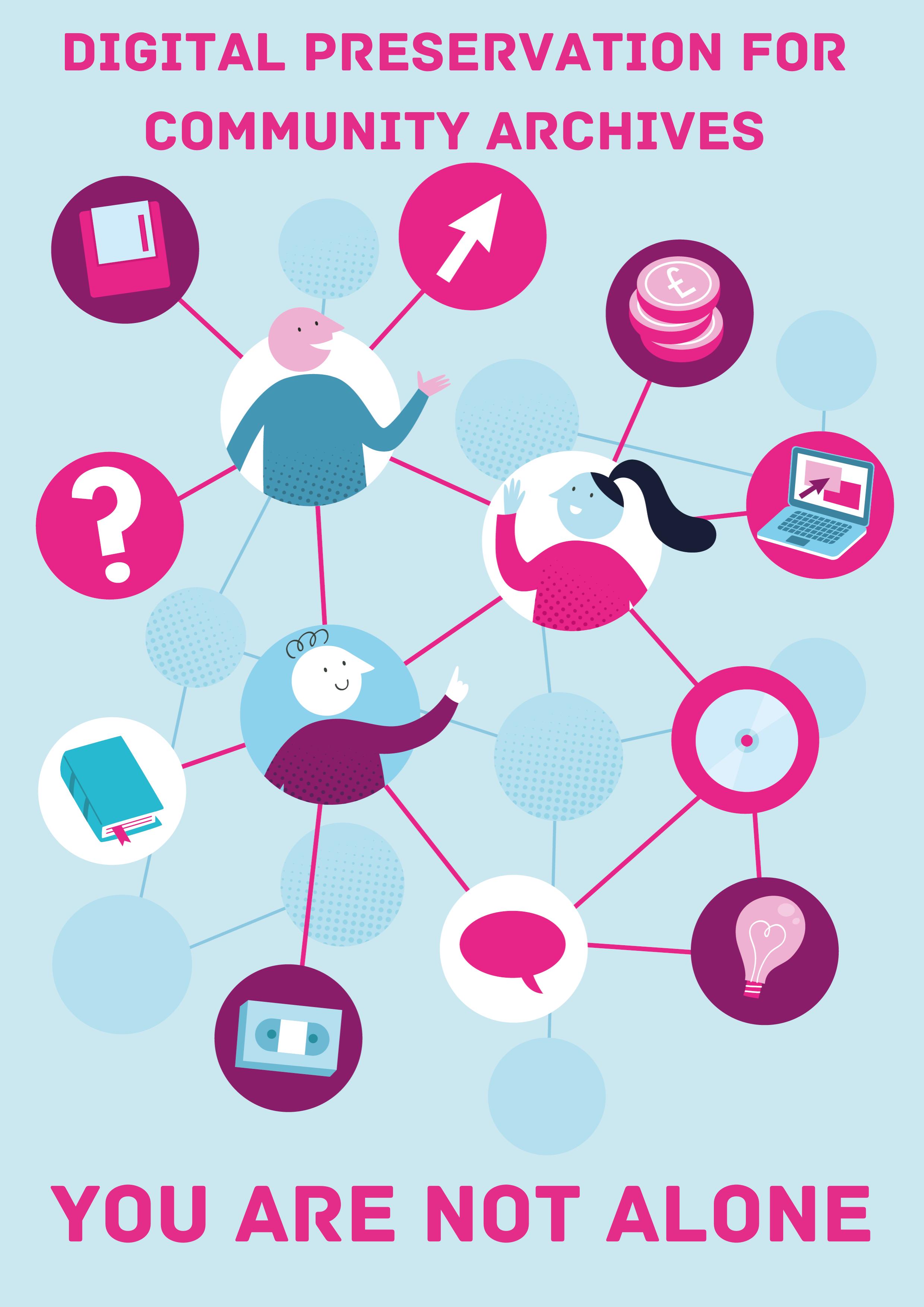 |
Whether you are at the beginning of your journey into the world of digital community archives or are further down the road, it can sometimes feel like you are on your own and which route to take next is unclear. Preserving digital content is a complex and ever-changing task, but you are not alone, and help is out there. It is important to remember that the best option may differ depending on the group you are part of and the records you collect. Every community group working with records is different, but they all share the same passion for collecting and sharing the collections in their care. Your group is best placed to decide what the best option is for the records in your care going forwards. |
Broadly speaking, there are 4 ways your community group can operate. They are:
Collect and Manage Locally – Create, collect and curate your own content and manage it within your own community. You will handle all areas of collection management and promotion on your own.
Collect and donate to archive - Create and collect your own content and pass it to a cultural heritage institution to preserve long-term. You have the option to curate and manage the content before transfer, or you can ask the institution to do this after transfer.
Collect, manage locally and promote nationally - Create, collect and curate your own content and manage it within your own community. You will handle all areas of collection management. You will send your collections data to an institution like TNA’s Manage Your Collections, or the Archives Hub, who will provide access to your catalogue and provide opportunities for Nationwide promotion.
Work with other communities – Collaborate with other community groups to share knowledge and tasks related to management of your digital content.
No matter how your group chooses to operate, there is help and support available at all stages of your digital content preservation journey. We are a global, friendly and welcoming sector and there are a range of organisations and resources available both online and in person. Just some of these are listed below.
National Organisations
|
|
|
|
|
|
|
|
|
|
|
|





Local Help
If you would prefer to seek help locally, every local authority or county council in the UK has an archive with at least one member of staff who will do their best to help you solve any problems you have.
In addition, peer support may be available from other community archive groups in your area. The Community Archives and Heritage Group website has an interactive map where you can search for community groups in your area and find contact information.
Subcategories
Template for building a Business Case
This section provides guidance on the content that will be useful to include in your business case, but it will likely need to be adapted to the structure used in your organization’s template.