







































































































Future Nostalgia: Safeguarding the knowledge of floppy disks
Project Lead: Leontien Talboom Project partners: Digital Preservation Coalition, the Centre for Computing History, Conservation Department Cambridge University Library.
 |
 |
 |
Future Nostalgia: Safeguarding the knowledge of floppy disks began with a practical challenge. While working as a technical analyst with floppy disks at Cambridge University Library, it quickly became clear it was difficult to know how to start extracting and preserving floppy disk data. Existing guidance was often fragmented, highly technical, or focused on specific tools, and it was not always clear how to recognise whether a process had been carried out correctly. This uncertainty made even basic tasks feel challenging.
Conversations with colleagues and practitioners in other institutions confirmed that this was not an isolated experience. Many organisations held floppy disks but faced similar barriers: limited documentation, reliance on specialist knowledge, and uncertainty around workflows. While resources such as The Archivists' Guide to KryoFlux provide valuable technical guidance for specific tools, they do not encompass the wider range of knowledge needed to work confidently with floppy disks, including handling, cleaning, troubleshooting, and decision-making across different contexts.
The project emerged from this need. Its aim was not only to preserve the data stored on floppy disks, but also to capture and share the knowledge required to access it in a more holistic and approachable way. The central output, the Copy That Floppy! Guide, brings together practical experience, community knowledge, and experimental work into a single, open-access resource.
Collaboration was central from the outset. An initial workshop, organised in partnership with the Digital Preservation Coalition (DPC), helped define the scope of the project and identify key challenges faced by practitioners (a summary of the workshop was published here: https://digitalpreservation-blog.lib.cam.ac.uk/diskettes-and-discussions-what-we-learned-from-the-future-nostalgia-workshops-021d51e4344e). This partnership continued throughout the project, including support for the Festival of Floppies event (described below) and the long-term hosting and maintenance of the guide, helping to ensure its sustainability beyond the life of the project. The final launch event, Copy That Floppy! LIVE, was also hosted by the DPC as a way of celebrating the publication of the guide and sharing it with the wider community.
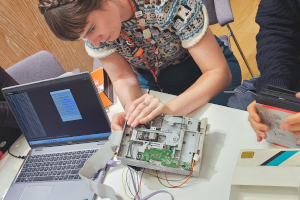
A key focus of the project was capturing knowledge that is often informal and experience-based. Interviews with retro-computing enthusiasts and practitioners provided insight into the realities of working with legacy computer hardware; what tends to go wrong, how to troubleshoot issues, and how to recognise when processes are working as expected. These interviews have been integrated into the guide, but are also openly accessible on the Cambridge Research Repository (https://www.repository.cam.ac.uk/items/154ad280-7c47-49eb-9cbf-24b6762f6c1c, and https://digitalpreservation-blog.lib.cam.ac.uk/floppy-disks-forgotten-systems-and-fragile-knowledge-insights-from-the-retro-computing-community-b036806f5a57). This was complemented by practical experimentation carried out with the Conservation Department at Cambridge University Library, exploring approaches to cleaning mouldy disks prior to imaging (https://digitalpreservation-blog.lib.cam.ac.uk/fuzzy-logic-cleaning-floppy-disk-with-our-conservation-department-part-one-c2d3e0320a2c, https://digitalpreservation-blog.lib.cam.ac.uk/fuzzy-logic-cleaning-floppy-disks-with-our-conservation-department-part-two-4ae2bbc0e779).
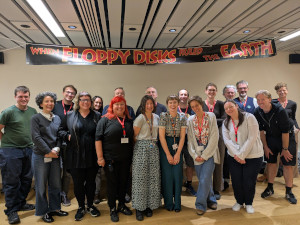
The development of the guide was iterative and shaped through engagement. The Festival of Floppies (https://digitalpreservation-blog.lib.cam.ac.uk/preserving-digital-memory-at-the-festival-of-floppies-200f01092738) workshop played a particularly important role, bringing together practitioners, members of the public, and collaborators including the Centre for Computing History. This exchange created an opportunity to share approaches across different communities, with digital preservation practices informing hands-on work and vice versa. Feedback from this event, along with contributions from professional mailing lists and online forums, helped refine the guide and ensure it addressed digital preservation needs.
The project also engaged widely with the professional community. Presentations at a number of conferences, including No Time to Wait! 9 and iPRES 2025, provided further opportunities to test ideas and gather feedback.
Beyond our community, the project has attracted significant public and media interest. Coverage from outlets including BBC Future (https://www.bbc.co.uk/future/article/20251009-rescuing-knowledge-trapped-on-old-floppy-disks), NPR (https://www.npr.org/2025/10/26/nx-s1-5582312/floppy-disks-get-a-second-life-at-cambridge-university-library), and Popular Science (https://www.popsci.com/technology/floppy-disk-archivist-project/) highlights the broader relevance of floppy disk preservation and the risks associated with digital obsolescence. Public-facing events such as the Copy That Floppy Café (https://www.lib.cam.ac.uk/research-institute/events/floppy-disks-workshop), which was part of the Festival of Floppies event, further emphasised the personal value of the data stored on these media, allowing participants to recover and reconnect with their own digital histories.
The resulting Copy That Floppy! Guide is designed to be practical, inclusive, and evolving. It brings together guidance on imaging, handling, cleaning, and troubleshooting, providing a clearer starting point for those new to working with floppy disks while also supporting more experienced practitioners. Recognising that no single resource can be complete, the guide is hosted on GitHub, allowing it to be updated and expanded as new challenges, tools, and approaches emerge. There is already a recognised need for additional quick-reference materials, such as a cheat sheet, which may develop over time as the community continues to use and contribute to the guide.
Importantly, the guide is hosted by the DPC, providing a level of sustainability and ongoing stewardship that supports its long-term use. This ensures that it can continue to evolve in response to community input rather than remaining a static output.
More broadly, the project highlights an important aspect of digital preservation: the need to capture not just data, but the knowledge required to access it. By documenting workflows, challenges, and decision-making processes, Future Nostalgia contributes to a more sustainable approach to managing legacy media.
While focused on floppy disks, the project has implications beyond a single format. The challenges it addresses around uncertainty, fragmentation of knowledge, and reliance on individual expertise, are common across many areas of digital preservation. By systematically capturing and sharing practitioner knowledge in an open, collaborative way, Future Nostalgia offers a model for how communities of practice can make their expertise more accessible, reusable, and sustainable over time.